
Study Tour Commences
 Sunday the 23rd of September I flew into Bangkok, Thailand with mixed expectations. Had my research topic been misguided, and would I face a harsher reality of what the country is really like? I was worried that what I had read in the past may have been viewed with a more western perspective and that Thailand was far less developed than I had originally thought. I couldn’t have been more wrong. As I landed at Suvarnabhumi Airport I was immediately shocked by the scale and technological attributes of the building. Then to leave the airport and travel to the hotel there was billboard upon billboard advertising some sort of ICT device or network. This gave me great confidence in my research topic and food for thought for further questions to ask on the “official visits”.
On the First day, we visited the National Institute for Development Administration, where ASEAN was the main focus but provided some solid feedback for the state of the governments in South-East Asia and reasoning behind why things move so slowly. The next stop was the ILO where I learn about the International Labour Organisations goals for better work and asked questions about unemployment caused by automation and factory conditions. This was helpful as they shed light on the new method to calculate unemployment and how it affects the validity of past data. The place I gained most information relating to my research was the World Bank in Bangkok where the topic of ICT investment was covered quite a bit with the lead economist currently looking into a similar research topic to mine. He also led me in the direction of the world development report where lots of data relating to my topic sits. Overall these visits were extremely helpful in establishing a clear research topic and gathering data.
One more main challenge remains in my research as I am struggling to find precise data on ICT capital accumulation in Thailand, as it’s national accounts data does not have a separate category for ICT or technology.
Over the next few days in Vientiane, I am hoping to gather information on the state of telecommunications in Laos and whether I should also use it in my research as a comparative aspect to my report.
Further down the road
 Since the last time I checked in much more research has been done as my attention has shifted towards other literature on the topic of the utilisation of technology in the modern Thai economy. In many articles and academic journals, the term “Thailand 4.0” has arisen as a result of the policies put in place by the Thai government since 2005, highly incentivising investment in information technology. This highlights Thailands natural progression from 1.0 being agriculture, 2.0 light industry, and 3.0 heavy industry. Thailand 4.0 is said to achieve a value-based economy, to rival a creative economy based on innovation such as South Korea.
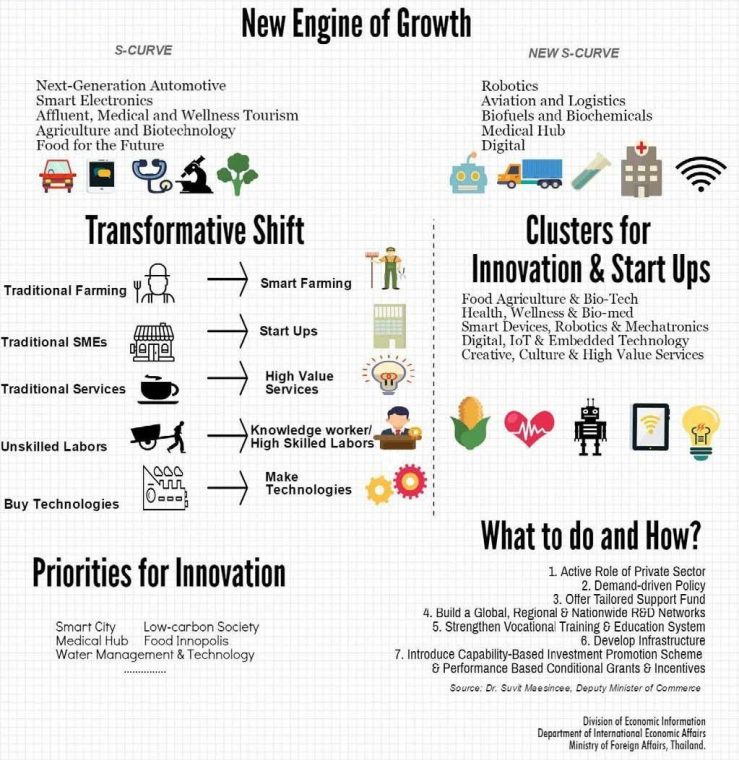
Thailands businesses are primarily comprised of Small and Medium Enterprises or SME’s which make up 98% of all businesses and 37% of Gross Domestic Product. The aim of Thailand 4.0 is to create a natural environment for technology-based companies to flourish as businesses become more efficient. Mckinsey and Company released a report in April 2017 stating that a 20% increase in Information Technology investment would lead to a 1% growth in GDP.
This shift to technology is not all positive or without any setbacks as there is now a severe shortage of skilled workers, unable to meet the demand of the economy’s blistering pace. This may eventually lead to structural unemployment as old, low skilled employment dries up. Thailand may need to begin investing in educational strategies and explore western ideas to keep up with its growth requirements.
This discovery of new research and data has opened up a whole world of new avenues to explore in my studies and I can’t wait to get back to you with what I’ve been doing over the next few weeks.
And Deeper We Go
 Welcome back for the second instalment of my weekly blog!
Over the past week, I have been developing my research questions further to really find what it is that I will be compiling into my report later this semester. I have found various sources of data which further the purpose of my research and emphasise the tech industry in Thailand as a driver for the economy. This includes research by MIT on ‘The Observatory of Economic Complexity’ showing the breakdown of all exports from the country. ( https://atlas.media.mit.edu/en/profile/country/tha/ )
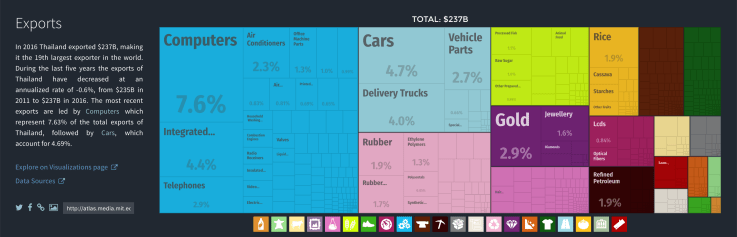 With this new data, I am more confident in my choice to delve into the tech industry and its effect on the economy. This site is quite intriguing as it raises more interesting questions about individual exports and it’s economic components. I now want to look further into countries that Thailand relies on to buy their tech goods such as computers and integrated circuits. Does the economic prosperity of the major importer’s of Thailands tech industry affect the overall trade balance in the economy? This opens up another angle for research questions involving Thailands dependence on the rest of the world. (Even more regressions, YAY!).
I’m happy with the pace I’m setting at this current stage and can’t wait to check back in next week!
It’s Time For Tech in Thailand

Over the past few centuries, the world has experienced pivotal revolutions changing the way people consume, produce, and work. The Industrial Revolution of the 1700-1850’s was the catalyst for the advancement of the world’s economy from the dark ages to the modern era. We now live in a time following another revolution, restructuring the world dynamic and propelling us further forward as a more cohesive society, the technological revolution.
The technological revolution began in the 1950’s and held its course, establishing itself in the mainstream by the late 1990’s with the mass adoption of the world wide web. The introduction of such technologies saw its adopting countries shoot forward into economic prosperity, with a dramatic increase in productive efficiency and communication.
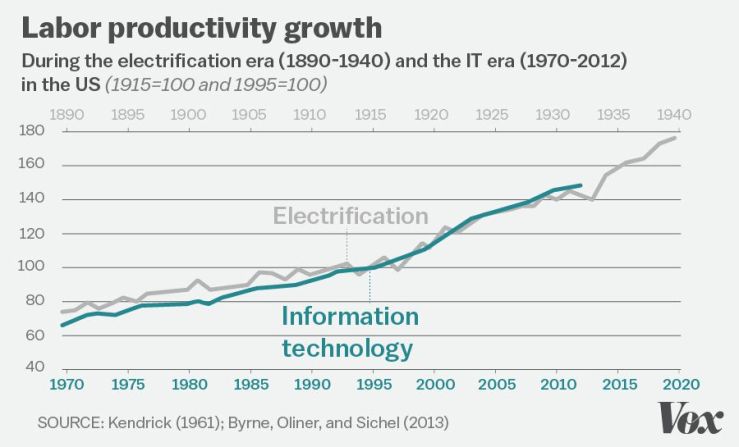
The graph below shows a comparison of the growth in labour productivity between the years of electrification and information technology. The blue line shows that information technology holds similar growth prospects as electrification did centuries ago.
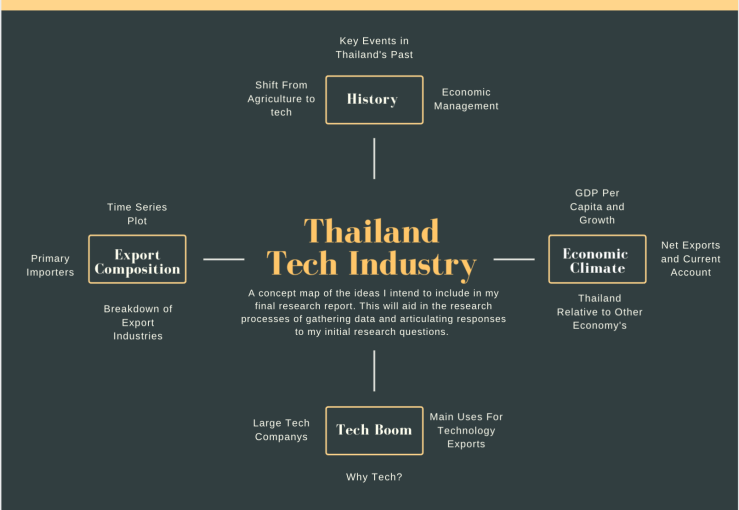
So how is this related to my research? I’m glad you asked. Thailand’s economy has historically been backed by its agricultural sector and recently (in the past 20 years) has shifted its focus towards the technology sector. With success stories such as Silicon Valley and China, Thailand has seen great potential in the current market for the production of computers and integrated circuits, now making up the majority of its export composition. So naturally, I want to investigate the effect this shift from agriculture to technology has had on the economy, analysing changes in key economic indicators such as GDP per capita and Net Exports through a VAR Regression Analysis. Below is a concept map outlining the aspects of the Thai economy I intend on exploring into deep detail.
I feel as if this line of research will play to my strengths as I have always been intrigued by the tech industry’s contribution to the economy and I feel comfortable with the VAR regression analysis required for this study. Articulation and concise writing will be the main skills I have to work on during the research process to present the best report possible.
I will post periodically to check in with how my project is progressing, and update you on my experiences in Thailand and Laos.
But for now, more data mining…
 Economic Adaptation